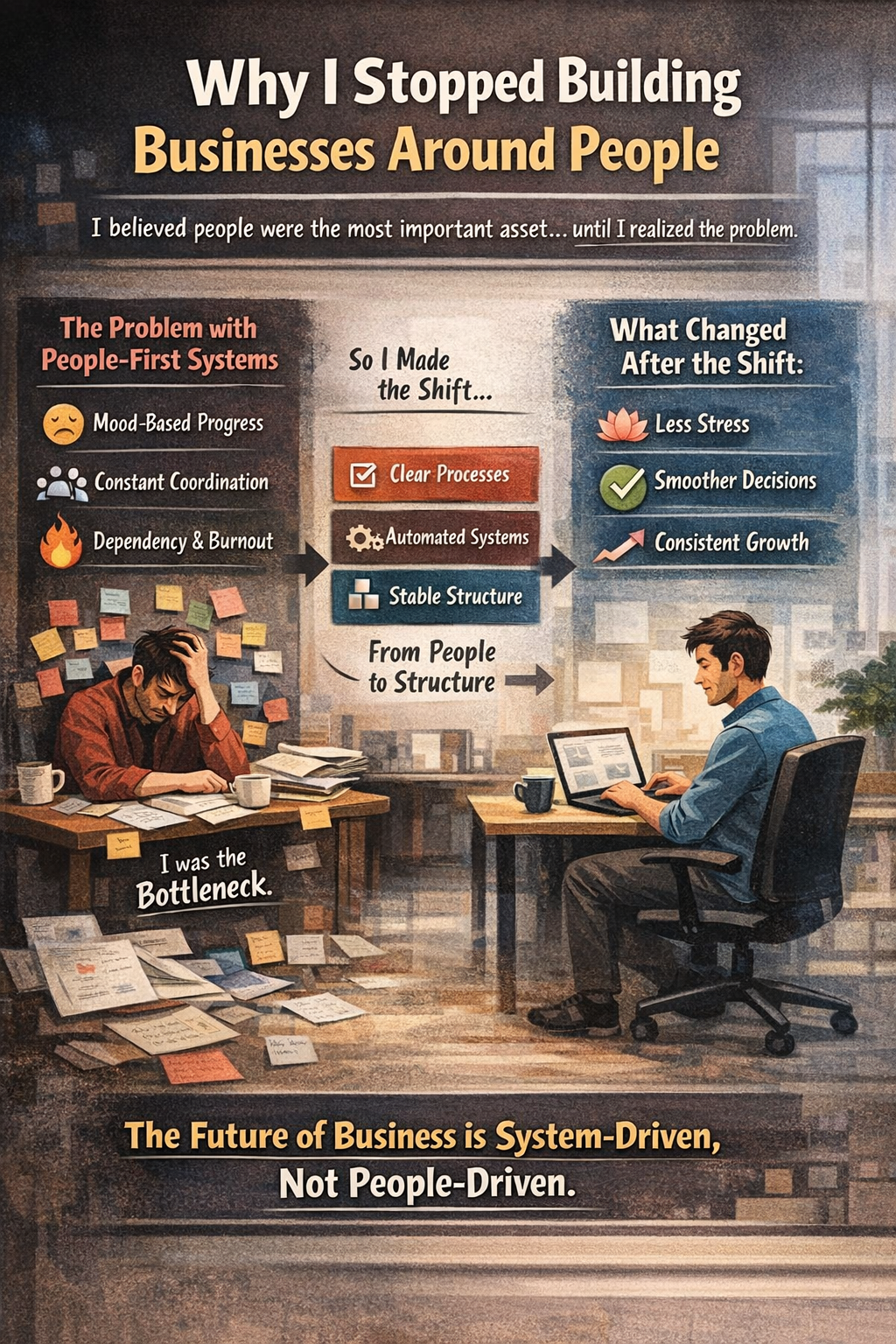
For a long time, I believed the most important asset in a business was people.
The right partners.
The right team.
The right energy at the right time.
And while people are important, I eventually realized something uncomfortable:
Building a business around people also meant building a business around fragility.
When people are the system, everything becomes unstable.
Progress depends on moods.
Consistency depends on motivation.
Growth depends on constant coordination.
At first, this feels normal. Even exciting.
You’re busy.
You’re involved.
You feel needed.
But over time, the cracks start to show.
Every explanation has to be repeated.
Every follow-up depends on memory.
Every slowdown creates anxiety.
The business doesn’t run unless you are present.
And that was the moment I started questioning the foundation itself.
Not the people.
Not the effort.
But the structure.
When Effort Becomes the Bottleneck
Most burnout doesn’t come from laziness or lack of discipline.
It comes from being the central operating unit of everything.
When you are
the reminder,
the explainer,
the follow-up system,
and the decision filter,
your energy becomes the bottleneck.
The business grows only as fast as you can respond.
I realized I wasn’t running a business.
I was managing a constant stream of human dependency.
And that dependency was invisible — until it became exhausting.
The Problem With “People-First” Systems
“People-first” sounds noble.
But without structure, it hides a dangerous assumption:
That people will always be available, consistent, and aligned.
They won’t.
Life happens.
Motivation fluctuates.
Priorities shift.
When a system requires people to remember, remind, and manually coordinate, it is already fragile.
This doesn’t mean people are the problem.
It means people should not be the system.
The Shift: From People to Structure
The turning point came when I stopped asking:
“How do I get better people?”
And started asking:
“What should not depend on people at all?”
That question changes everything.
Instead of relying on conversations, I focused on clarity.
Instead of repeating explanations, I designed education.
Instead of chasing follow-ups, I built sequences.
The goal wasn’t automation for speed.
It was structure for stability.
What Changed After the Shift
Something unexpected happened.
Conversations became shorter — not longer.
Decisions became calmer — not rushed.
The right people stayed.
The wrong ones filtered themselves out.
Not because I pushed less —
but because the system carried more.
When structure replaced dependency, the business stopped feeling heavy.
A Different Way to Think About Growth
Growth is often framed as:
“More people.
More effort.
More output.”
But sustainable growth looks different.
It looks like:
-
Fewer explanations
-
Clearer pathways
-
Predictable flow
It looks like a business that can run even when energy dips.
That’s when I understood something fundamental:
The future of business isn’t people-driven.
It isn’t tool-driven.
It’s system-driven.
And that realization became the foundation of everything I rebuilt after.
Louis Zeus writes about business structure, decision-making, and why effort-based models often break down over time. With 14 years of experience in online marketing and network-based businesses, his work focuses on helping people evaluate opportunities calmly — before committing time, energy, or money. This blog is not about motivation or quick results.
It’s about understanding structure first, so decisions are made with clarity. Learn more of Louis’ work on structure-based systems: https://structure.louiszeusmarketing.com/systems